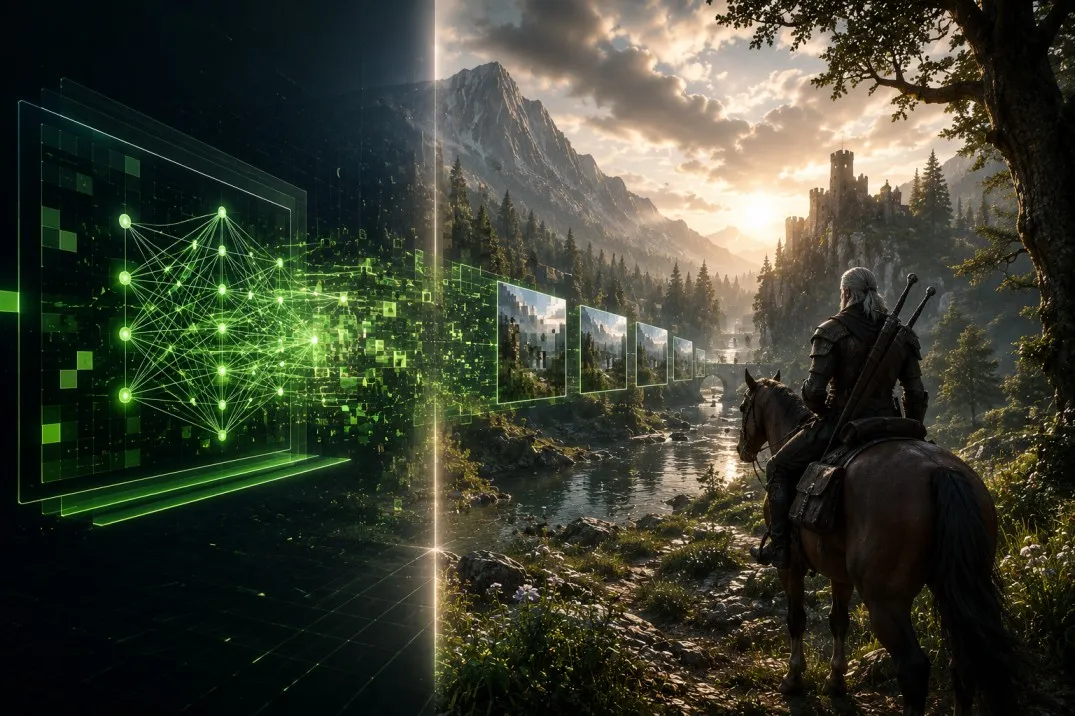
Nvidia just dropped one of its boldest claims in years, calling DLSS 5 the most significant breakthrough in computer graphics since real-time ray tracing debuted back in 2018. That is a bold comparison, and DLSS 5 game graphics are already generating intense discussion among gamers and developers alike. Unveiled at GTC 2026, this is not a simple performance update. It represents a fundamental shift in how Nvidia approaches rendering itself.
If you are wondering what DLSS 5 actually changes, when you can use it, and whether the hype matches reality, here is the complete breakdown.
The Big Reveal at GTC 2026
Nvidia CEO Jensen Huang unveiled DLSS 5 during the GTC keynote on March 16, 2026, framing it as a reinvention of computer graphics itself. Huang specifically noted that this announcement comes twenty-five years after Nvidia invented the programmable shader, drawing a deliberate line connecting that earlier graphics milestone to this new generative rendering approach.
Unlike previous DLSS updates that focused primarily on upscaling and frame generation, DLSS 5 introduces what Nvidia calls a real-time neural rendering model. The core idea is that this model infuses pixels directly with photoreal lighting and materials, rather than simply reconstructing or interpolating frames the way earlier DLSS versions did.
How DLSS 5 Is Different From Previous Versions
To understand why DLSS 5 represents such a meaningful shift, it helps to look at what came before. DLSS has historically handled two main jobs: upscaling, which renders a game at lower resolution and reconstructs it using AI, and frame generation, which uses AI to interpolate entirely new frames between rendered ones. DLSS 4 pushed frame generation considerably further with Multi Frame Generation on RTX 50 series cards.
DLSS 5 moves into fundamentally different territory. Rather than only improving performance without altering pixel-level visual quality, DLSS 5 uses generative AI to directly modify pixels and inject photorealistic lighting and material properties into the rendered image. Nvidia refers to this internally as 3D-guided neural rendering, a technique aimed at closing the gap between real-time game rendering and the kind of photorealistic visuals typically associated with Hollywood visual effects work.
Major Publisher Support Already Confirmed
DLSS 5 is launching with backing from some of the biggest names in gaming. Nvidia has confirmed support from Bethesda, Capcom, Hotta Studio, NetEase, NCSOFT, S-GAME, Tencent, Ubisoft, and Warner Bros. Games. That is a notably broad coalition of publishers committing to the technology before its public release, suggesting Nvidia secured significant industry buy-in well ahead of the official unveiling.
Release Timing: What to Expect This Fall
Nvidia has confirmed DLSS 5 will roll out in Fall 2026, distributed primarily through updates via the Nvidia app rather than requiring an entirely new generation of hardware to access. Early adoption will focus on next-generation RTX graphics cards, though Nvidia has confirmed that current RTX 50 series cards, including the RTX 5070 and RTX 5080, will also be compatible.
That said, some industry observers have pointed out that early DLSS 5 demos were running on RTX 5090 hardware, raising reasonable questions about how the technology will perform on lower-tier cards once it actually ships. Nvidia has several months between the announcement and the fall launch to optimize performance across its broader GPU lineup, and waiting for independent benchmarks before drawing firm conclusions is a sensible approach.
Is DLSS 5 Optional?
Yes. Like previous DLSS versions, DLSS 5 will appear as a setting within the graphics options of supported games rather than being automatically forced on. If you are not interested in the AI-driven visual changes it introduces, you will be able to leave it disabled and continue using earlier DLSS modes or no upscaling at all, provided your hardware supports the alternative.
It is also worth noting that DLSS 5 is described as requiring a considerable amount of processing power, which lines up with the more demanding generative AI work happening under the hood compared to earlier upscaling and frame generation techniques.
DLSS 4.5 Is Already Here, Bridging the Gap
While DLSS 5 generates the most headlines, Nvidia has also been steadily rolling out DLSS 4.5 throughout 2026, giving players meaningful improvements while the bigger DLSS 5 rollout is finalized. Titles like 007 First Light launched with path tracing and DLSS 4.5 support, and Nvidia revealed at GDC that twenty games are either launching with or upgrading to DLSS 4.5. Crimson Desert and Death Stranding 2: On The Beach both launched featuring DLSS 4 with Multi Frame Generation as well, giving players plenty of supported titles to explore in the meantime.
Why Some Gamers Remain Skeptical
Not everyone has greeted DLSS 5 with unconditional enthusiasm. Because the technology directly modifies pixel-level lighting and materials using generative AI, some players have raised concerns about how authentic or consistent visuals will look compared to traditionally rendered graphics. This marks a genuine philosophical shift, and reactions within the gaming community have been notably divided between excitement over the visual potential and unease about handing more of the rendering pipeline over to AI generation.
These concerns are not unreasonable. Neural rendering is a genuinely new category of technology, and how it behaves across the wide variety of art styles and game genres on the market remains to be seen until broader hands-on testing becomes available later this year.
Final Thoughts
DLSS 5 game graphics represent one of the more ambitious technological bets Nvidia has made in recent memory. By shifting from pure upscaling and frame interpolation toward generative, pixel-level neural rendering, Nvidia is betting that AI can meaningfully close the gap between real-time game visuals and pre-rendered cinematic quality.
With major publisher support already locked in and a Fall 2026 launch window confirmed, DLSS 5 is shaping up to be one of the most closely watched graphics technologies of the year. Whether it lives up to Nvidia's lofty comparisons to the dawn of real-time ray tracing will likely depend heavily on real-world performance once it reaches consumer hardware later this year.
Frequently Asked Questions
What is DLSS 5?
DLSS 5 is Nvidia's next-generation graphics technology that uses a real-time neural rendering model to inject photorealistic lighting and materials directly into game pixels, going beyond traditional upscaling and frame generation.
When does DLSS 5 release?
Nvidia has confirmed DLSS 5 will launch in Fall 2026, rolling out primarily through updates via the Nvidia app.
Which GPUs will support DLSS 5?
Current RTX 50 series cards, including the RTX 5070 and RTX 5080, are confirmed to support DLSS 5, with early adoption focused on next-generation RTX hardware.
Is DLSS 5 mandatory in supported games?
No. DLSS 5 will appear as an optional setting in supported games' graphics menus, just like previous DLSS versions.
Which publishers are supporting DLSS 5?
Confirmed supporters include Bethesda, Capcom, Hotta Studio, NetEase, NCSOFT, S-GAME, Tencent, Ubisoft, and Warner Bros. Games.
How is DLSS 5 different from DLSS 4?
DLSS 4 focused on upscaling and AI-based frame generation without altering pixel-level visual quality, while DLSS 5 uses generative AI to directly modify pixels with photorealistic lighting and materials.
Does DLSS 5 require a lot of processing power?
Yes. Nvidia has noted that DLSS 5 demands considerable processing power due to its generative neural rendering approach, and real-world performance across different GPU tiers will become clearer once benchmarks are